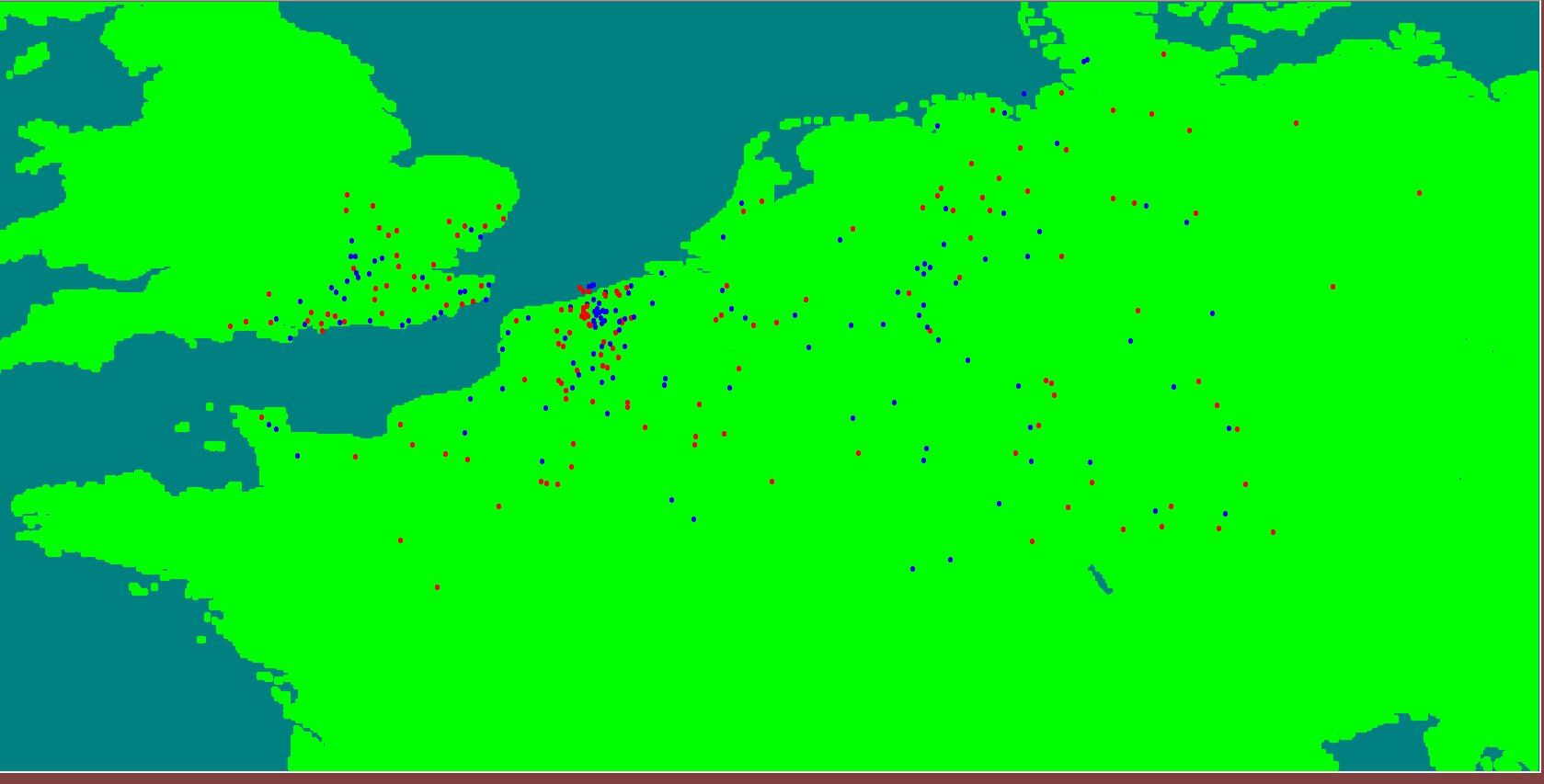
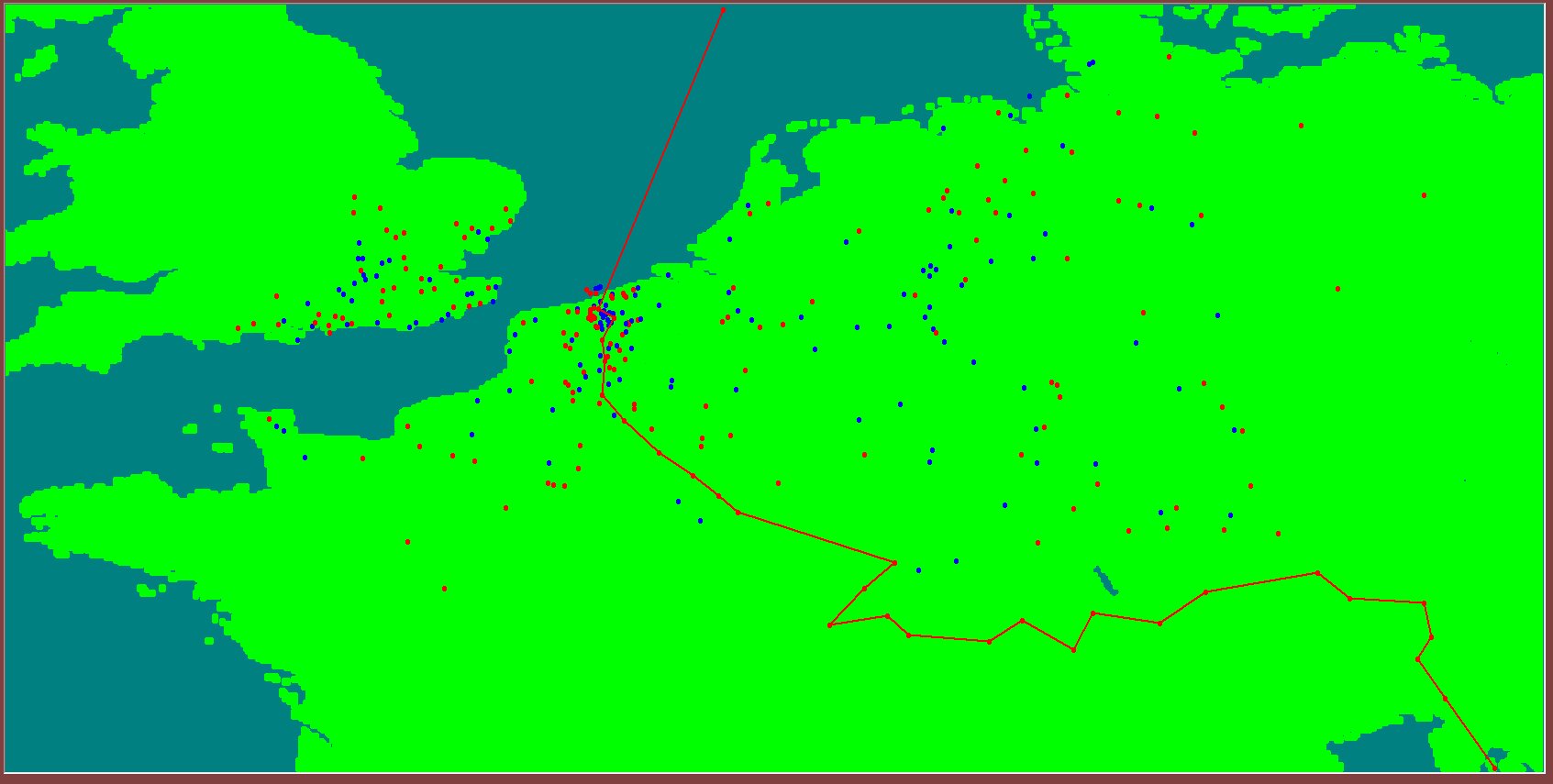
This is the target layout that the original TWF gang set up:
(not sure what those targets in the channel are. Suspect they were spare bases which were going to be used elsewhere)
As you can see the bases and target locations are very close together in the northern western front area: this shows it better:
The original TWF team frontline rune down the middle of this concentration of target locations.
We are going to have thin these out to make the scenario playable, a smaller collection of frontline bases and target locations for the western front, whilst keeping the major bases and towns (= bombing targets) away from the front.
My suggested new frontline makes possible some action in the Italian/Austrian front as well.
EAW2015 also has a target down there in Northern Italy, right on the coast. It's so close to the edge of the map that you hit it the border flying east by about 20 miles. Looks like your frontline is a little further north so that shouldn't be an issue.
I only put one target down there and no others along the frontline because I just wanted an excuse to put some WWII Italian fighters into the mix. I suppose you'll put a few more down there so it doesn't look so empty.
Of course, this means I'm going to have to come up with some Italian and Austrian aircraft.
Italian/Austrian aircraft not a priority at the moment. Something we can look to down the line, but I will put in some relevant targets down there. I did have some that way in my original 1940 setup.
I'm going to proceed by compiling a list of relevant bases and targets for each of the periods.
Moggy wrote: ↑Sun Mar 22, 2026 5:44 pm
My suggested new frontline makes possible some action in the Italian/Austrian front as well.
Regarding the Italian front, I have managed to gather some information; one page explains the situation of the Italian airfields and their location from June 21, 1915, to November 62, 1917.
I finally got around to checking. Mine says 22011 in the file name. I guess that's the date but seems kinda old.
Also, while searching for it I came across three WWI zip files. One is a set of screens, another is a target set and the third is a WWI German tank. I put copies in your folder on the off chance there's something of value in them.
Thanks Ray.
Regarding the Italian front, I have managed to gather some information
Great finds Ed, especially the Italian airfield map. I'm translating the Italian text.
Google Translation of the archived Italian website (in several parts)
1915
When war was declared, the Austro-Hungarian Air Force was not caught by surprise and immediately began its first reconnaissance and bombing raids. The same was true of the Italian Air Force, which in the first month of the war carried out reconnaissance over Podgora and attacked the Austrian naval base at Pola. On the first day of the war, a Blériot from the 1st Squadron flew over Sagrado, dropping a few small bombs. Almost all of the squadrons were deployed in Friuli to support the main army's operations. The Supreme Command, through Operation Order No. 1, assigned the squadrons of the 2nd Army the task of reconnaissance north of the Cormons-Gorizia-Aidussina road, and those of the 3rd Army were responsible for covering the area south of this same road. The other squadrons were to bomb the Gorizia airfield and guard the Tolmin-Krainurg, Gorizia-Ljubljana, and Monfalcone-Adelsberg roads. Between May and August 1915, the squadrons equipped with Blériots and Nieuport monoplanes received new aircraft. Their existing aircraft were obsolete and no longer adequate for the new military needs. The decommissioned aircraft were handed over to flight schools for use as trainers. At the same time, new units equipped with Voisins and Farmans were formed.
On May 30, 1915, the P4 airship took off from Campalto, commanded by Captain Giuseppe Valle and with Lieutenant Francesco Pricolo aboard. The clock read 7:35 PM and the sky was partially overcast with thunderstorms and rain. The airship was armed with four 162 mm torpedoes, four 130 mm torpedoes, and six incendiaries. It had a 12-hour endurance. After an hour, the altitude stabilized at 1,000 meters toward Pola, and at 10:30 PM, the P4 was over the city. The altimeter read 1,450 meters when the airship released its payload onto the arsenal. The incendiary torpedoes were dropped on Santa Caterina and some fuel depots. The response was intense; 34 photoelectric guns swept the sky, and a dozen anti-aircraft batteries opened fire. The envelope was lightly damaged, but the altitude gained by unloading the bombs allowed it to climb another 250 meters, entering the clouds and catching sight of the Moon. The aircraft turned and began its return flight, and after two and a half hours of flight, descending to 100 meters, it reached the Piave lighthouse. The commander announced the arrival by megaphone, and the aircraft landed at 2:40 a.m. Valle and Pricolo would later rise to the top ranks of the Air Force: the former between 1929 and 1939, the latter between 1939 and 1941. Valle would command the Air Force Academy and also participate in the Italy-Brazil cruise.
On the night of May 27, an Austrian seaplane, a Lohner L40, crash-landed in a marsh above Porto Corsini, between Comacchio and Codigoro. A certain Oreste Mondo noticed it among the reeds and called the guards, who surprised the pilots still busy repairing the plane and arrested them. The aircraft attracted great interest, as the Royal Navy's specific fleet of aircraft was rather limited. After being transferred to Porto Corsini, it was sent to Macchi, which dismantled it, obtained its drawings, and reproduced it within a month, using an Isotta Fraschini engine.
That same night, the M1 airship attempted to reach Ljubljana without success. It had departed from Campalto under the command of Captain Seymandi.
In mid-June 1915, the Artillery Squadrons were formed, equipped with Caudron and Macchi Parasol aircraft. These were stationed at the new airfields of Gonars, Oleis, and Medeuzza, starting in early July. Other airfields were subsequently established, including Santa Maria La Longa, Tombetta di Verona, Asiago, and Brescia, as well as the Desenzano seaplane base.
In Verona, in October 1915, the 1st Farman Squadron was stationed to defend the city, while at the beginning of the conflict, the 12th Farman Squadron was moved from Verona to Asiago to support operations in the 1st Army sector.
The First Battle of the Isonzo took place from 23 June to 7 July, during which the Austrians employed their air units for reconnaissance, successfully identifying Italian units on the front. The Cividale railway station was bombed, and four Italian captive balloons were attacked. Generally, Italian air support for the troops during this first battle, as in the second, was rather ineffective. The Italians carried out airship attacks that had little effect, such as the bombing of the Opicina station on 5 August. Given the relatively backward preparation of the air force, its action consisted of reconnaissance and artillery service.
Austria-Hungary did not yet deploy fighter units, nor did Italy, and the threat posed by anti-aircraft fire had to be measured against the actual capabilities of an artillery specialty that was still being organized on both sides. For reconnaissance aircraft advancing beyond the lines, however, this was the most concrete danger, and it was anti-aircraft fire that downed Italy's first aircraft lost in action. On the evening of July 27, a Nieuport of the VI Squadron was hit by shrapnel while entering the Karst plateau and was seen crashing in flames behind Point 77, southeast of Bosco Cappuccio. On board were the pilot, Marshal Luigi Rocchi, and Frigate Captain Ricccardo Cipriani as an observer. On August 7, 1915, D'Annunzio flew over Trieste aboard a seaplane from the Venice station, piloted by Giuseppe Miraglia, and dropped several patriotic leaflets.
On August 20, Caproni trimotor bombers made their military debut with a raid on Gorizia's Aisovizza airfield. In retaliation, the city of Udine was struck the following day. D'Annunzio repeated the Trieste feat over Trento on September 20, aboard a Farman of the XII Squadron departing from Asiago. The plane took off in the early afternoon under the command of Captain Ermanno Beltramo. The clouds that had covered the plateau that morning had cleared, and, passing Levico and Pergine, the aircraft landed over the city at an altitude of 3,000 meters. Beltramo reduced altitude, and the two dropped small sandbags with a tricolor stripe attached, on which propaganda messages were pinned. The plane returned to base at 5:50 PM.
From October 18 to November 4, the Italian army conducted the third Isonzo offensive, which saw a widespread increase in air activity. On October 19, the Aisovizza airfield was successfully attacked, while the Austro-Hungarians increased their reconnaissance of the Veneto plain. On November 14, 1915, Verona was bombed by three planes, dropping 15 bombs. The toll was grave: 37 dead and 29 wounded. Fighter aircraft arrived late, sparking heated controversy. The commander of the city's air defense, Captain Amedeo Ferraro, was reprimanded for his inefficiency. At the end of the year, the entire air force underwent a restructuring, resulting in a total of 23 squadrons and a seaplane section, divided as follows: three defense squadrons (fighters), six new offensive squadrons on Caproni bombers, nine reconnaissance squadrons, and five artillery squadrons. On the 23rd of the same month, a Nieuport section was detached to Cascina Farello from the French squadron N92/I, which had grown in size in the meantime. It returned to the Lido only on October 24, 1917. On December 21, 1915, Giuseppe Miraglia, a lieutenant from Lugo, lost his life in a test flight that, taking off from the Sant'Andrea seaplane base, ended in a tragic accident. He was the commander of the San Marco Squadron. The Venice base was then called Stazione Miraglia. At the beginning of December 1915, the VIII Nieuport Squadron had been renamed the 1st Squadron and equipped with the Ni.10 single- and two-seaters. Air activity during the first year of the war appears particularly limited today: the Italians recorded only seven dogfights, 41 photographic missions, and 28 ground attack missions.
1916
During the winter months and spring of 1916, no major operations took place along the long front from the Stelvio Pass to the sea. The weather did not permit this, and while awaiting the return of good weather, the two armies used the long operational stalemate to reorganize and strengthen their forces. The first programs to strengthen the Italian Air Force were aimed, on the one hand, at expanding the presence of the air force and, on the other, at increasing its offensive capability. On January 16, a 5th Fighter Squadron mounted on Aviatiks was formed and deployed to Taliedo to defend Milan. Two days later, the 4th Reconnaissance and Combat Squadron, mounted on Farman aircraft, and the 7th Offense Squadron were activated in Pordenone, bringing the number of Caproni squadrons available to the Supreme Command from the Aviano and Comina airfields to six. On January 22, the Desenzano seaplane section transformed into the 1st Squadron. A new Fighter Squadron, the 2nd, was formed at La Comina with the task of escorting the Caproni bombers. It was equipped with Nieuport aircraft and in March was transferred to Cascina Farello to operate, alongside the French, in the Adriatic sector. In the first weeks of 1916, the Caproni squadrons were employed on in-depth reconnaissance missions to verify the veracity of rumors regarding the arrival of new Austrian units and whether a new airship hangar was under construction near Fiume. On January 3, 1916, Verona, defended by Captain Bonazzi's 1st Squadron, was once again the target of an Austrian air raid. This time, however, the defense was up to the task, and the raiders were forced to drop their bombs at random on the Castelfranco Veneto area.
On January 11, nine Austrian seaplanes attacked Rimini, causing some damage to buildings and prompting the Supreme Command to launch a raid on Ljubljana, which had long been identified as a possible retaliatory target. With the Italian air force succumbing to the enemy's initiative, on February 12, Austro-Hungarian seaplanes attacked the Codigoro pumping station, resulting in six deaths, and Ravenna, resulting in fifteen casualties. On February 14, aircraft taking off from the fields of Trentino attacked Schio, resulting in five deaths, and Milan, attacked by Gardolo's Flik 17, targeting the Lombardy capital's power plants. That same day, the Supreme Command ordered a return attack on Ljubljana as soon as weather conditions permitted. At the beginning of December 1915, the VIII Nieuport Squadron was renamed the 1st Squadron and equipped with single- and two-seater Ni.10s. Its base was at Santa Caterina, near Campoformido, and its task was the defense of Udine. In February 1916, it was equipped with some new Ni.11 "Bebè" aircraft. Captain Francesco Baracca was a member of the unit. At the end of the year, the unit effectively became a fighter squadron under the new regulations. On April 7, Francesco Baracca shot down and forced down the Brandenburg Albatros 61.57 of Flik 19. The future ace thus achieved his first victory, which was also the first official victory for an Italian fighter. In the same month, the unit changed its name to the 70th Squadron, the new designation adopted on April 8, 1916. Between March and April 1916, Luigi Bresciani's torpedo bomber was tested at Sant'Andrea. It was a completely redesigned "Ca3," sharing only the three-engine design with a twin-spar fuselage with the "Caproni." The flight results were encouraging, but on April 3, the aircraft crashed after takeoff, killing the entire crew—Luigi Bresciani himself and Roberto Prunas as pilots, and mechanics Fausto Lari and Vittorio Pontoni. The project was subsequently abandoned.
On April 8, 1916, all squadrons were renamed according to a new, single system, which would remain in effect until the end of the war. In the spring of 1916, new airfields were set up at Belluno and Villaverla (VI). The 48th Squadron was stationed in the former, and the 27th, 28th, and 32nd squadrons in the latter, all equipped with Farman aircraft. The 48th Squadron would become famous and, having switched to twin-engine Caudron G.4 aircraft, would count among its ranks top pilots such as Felice Porro, Aldo Finzi, Natale Palli, Pietro Massoni, and Giuseppe Sarti, who would link their personal histories to that of another famous squadron, the 87th Serenissima Squadron, remembered for its epic flight over Vienna, in which D'Annunzio also participated. The 48th Squadron was particularly busy across a broad front, from Feltre to Cadore, flying very long missions at altitudes consistently above 3,000 meters, in freezing temperatures. On April 20, 1916, seven Capronis struck the Trieste seaplane base, dropping 60 bombs and causing extensive damage. Nine civilians also died. With spring arriving along the entire front, especially in the Isonzo region, the Austro-Hungarian Air Force continued to hold the initiative, although it did not develop tactical reconnaissance operations to the level of those performed by the Italian squadrons, and instead concentrated its efforts on in-depth reconnaissance and bombing operations. In the final days of March, a raid on the railway bridges over the Piave River was planned, which was intended to inflict a severe blow to the Italian army's lines of communication.
The operation, designed to hinder the transfer of forces from the Isonzo to Trentino and thus indirectly support the offensive underway between the Adige and Brenta rivers, was launched on March 15th with the participation of all the aviation companies, or Fliks, and the Navy's seaplanes. Bad weather and some doubts among the commanders conspired to ensure that the executive order was not given until the evening of March 26th. However, the 83 aircraft that took off the following day, between 4 and 5 a.m., from the Isonzo and Trentino airfields and from the Trieste seaplane base, encountered prohibitive weather conditions over the Veneto plain. The three bridges of San Donà, Ponte di Piave, and Priula were obscured by thick fog. The situation at the secondary objectives, identified as the Veneto railway stations, was no better. Despite the effort, the results were negligible, with four aircraft lost, having landed within Italian lines due to engine problems or having lost their way. On the Trentino front, the harshness of the season had an immediate impact on the flight activity of the squadrons in that sector (III Group). After the raid of January 10, 1916, when three trimotors from the 5th Squadron and several Farmans from the 1st and 12th attacked the Gardolo airfield, no further bombing operations took place for over three months. On the Lavarone and Folgaria plateaus, what was still the 12th Squadron continued to carry out its reconnaissance operations, increasingly supported by the 1st.
1917
According to the Supreme Command's plans and the programs agreed upon at the time, upon resumption of operations in the spring, the Italian Air Force was to deploy 30 reconnaissance squadrons, mounted on single- or twin-engine Savoia Pomilio aircraft, 38 fighter and defense squadrons, of which 10 Nieuports, 14 on two-seater Pomilio type C aircraft, 14 on SAMLs, 20 offense squadrons on 450 HP Caproni trimotors and 4 squadrons of FBA seaplanes. In reality, on February 10, 1917, on the Italian, Albanian, and Macedonian fronts, there were a total of 20 reconnaissance squadrons mounted on Farman, Voisin, and Caudron aircraft, and 5 defense squadrons mounted on Farman and SAML aircraft; 7 fighter squadrons and one section mounted on 80 hp Nieuport aircraft; 12 Caproni bomber squadrons mounted on 300 or 350 hp Caproni engines; and 2 seaplane squadrons. With the exception of the fighter squadrons, which, however, needed to replace the 80 hp Nieuport with the 110 hp type as soon as possible, and the two reconnaissance squadrons that had a few twin-engine Caudron G4 aircraft, all the other squadrons were equipped with obsolete or worn-out equipment. One of the most influential journalists of the time, Luigi Barzini, forcefully reintroduced the "aviation question" in a front-page article in the "Corriere della Sera" on March 5, 1917. The article focused on the need to keep pace with the rapid development of aeronautical technology: "A fundamental, inexorable, and inevitable law must always be kept in mind by those responsible for air training: In wartime aviation, the old, the backward, the outdated is null and void." On January 13, 1917, the 78th Squadron at Istrana was joined by the newly formed 79th Squadron, recently formed at Arcade. The newly formed formation was assigned to the Second Army to operate on the highlands. It had 80-hp Nieuport 11s and was commanded by Captain Francesco Chimirri. In addition to the commander, nine other pilots served there: lieutenants Cesare Bertoletti and Umberto Mazzini, second lieutenant Alberto Moresco, marshal Giovanni Attili, corporals Marziale Cerutti, Attilio Imolesi, Giovanni Nicelli and Antonio Reali and private Vittorio Melloni.
On January 22, 1917, one of Istrana's pilots, serving with the 78th Squadron, was killed. Sergeant Augusto Vola, who died in a tragic accident when the wings of his Nieuport broke, lost their lives. Between March and April 1917, the Italian air forces underwent a new reorganization: Army-level aviation commands were established, while the photographic squadrons were transferred to the Supreme Command. The artillery aviation was also suppressed. The 78th and 79th squadrons were incorporated into the X Group, and each of them detached a section to Friuli for operations on the Isonzo. The 79th was also called upon to detach another (the III) to Padua for the defense of the city. In April, the 252nd Squadron was formed at the Sant'Andrea seaplane base, with elements from the 2nd Squadron of the Venice Seaplane Station. It was commanded by Captain Paolo Avogadro, who had Army and Navy personnel under his command. The new formation was tasked with defending the city. Its insignia were the black stripes on the tails of the F.B.A. of the Venice Seaplane Station that manned it. For this reason, it became known as the "squadriglia delle bande nere," a name that echoed the ancient exploits of Giovanni de' Medici and his Tuscan company of mercenaries. On April 17, 1917, the gray sky of a cold and stormy day provided the backdrop for a new Austrian attack on Venice. The sea in front of the city was rough when, at 11:00 a.m., a formation of several Habsburg seaplanes headed for the lagoon capital. Twelve aircraft took to the skies to defend the city. Four were FBAs that had taken off from Sant'Andrea. Another four FBAs had taken off from Grado, while the last four Nieuport 17 aircraft had taken off from San Nicolò. Two of the seaplanes from Sant'Andrea were unable to fire. The gun of the first jammed immediately, while the gunner of the second, with his hands now almost frozen, was in no condition to fight.
Firing from afar, Italian pilot Giulio Viner managed to hit the Austrian seaplane K192, forcing it to ditch. Our other aircraft returned to their respective bases, while Viner, who had also been hit by fire from the raiding aircraft, was also forced to ditch. He touched down near the mouth of the Piave River. The pilot was towed by a minesweeper, and as soon as a French seaplane flew over it, he signaled it to ditch so he could be picked up and rejoin the Austrian plane. Shortly thereafter, however, two Double-Headed Eagle naval vessels appeared in the area. At that point, Viner and his French colleague decided to return. Meanwhile, at the Sant'Andrea seaplane base, someone else had decided to attempt to recover the Austrian seaplane. These were Avogadro and Captain Bonsembiante, who arrived in the area aboard their FBA. The sea, however, was very rough, and when the plane hit the waves, it capsized. At this point, the four Italians and Austrians were all in the water, a few hundred meters apart. A French FBA reached the area, but when the aircraft attempted to land, the force of the waves was such that a float was torn off. The pilot quickly regained the air and returned to Venice. The area was then also overflown by Ensign Agostino Brunetta aboard a Macchi L3, who managed to disembark and take the four unfortunates on board. However, he was unable to take off. Meanwhile, a storm had broken out. Heavy rain lashed the five shipwrecked men. By four in the afternoon, a ship approached, responding to the signals of our pilots. Unfortunately for them, it was an Austrian vessel that took them prisoner. During that day's raid on the lagoon city, two more aircraft were shot down: the Austrian K188 which, on a rescue mission, was searching for the K192 and collided with the aircraft piloted by 2nd Chief Minciotti and 2nd Chief Zanetti, and a French FBA which attempted to attack the ship that had captured the Italians.
Also in April 1917, the 32nd Squadron was assigned to the San Pietro in Gu airfield, and shortly thereafter, the 32nd and parts of the 26th Squadron were stationed at the same airfield, all with reconnaissance duties. The 2nd SVA Section also passed through this airfield, and, in March 1918, a section of the 83rd Squadron. This unit was unusual in its composition. It was formed with three sections, all sent to different fronts: one to Macedonia, one to Belluno, and the third to Cavazzo Carnico. It was the third that was ultimately assigned to San Pietro in Gu. This site, and the adjacent Casa Piazza extension, were also home to the 66th Squadron of the British Royal Flying Corps, which arrived there in March 1918 and remained there until the end of the war.
Among the targets of the Austrian bombers, already identified at the beginning of the conflict, were the locks and drainage systems in the Po basin. If destroyed, they could cause widespread flooding that would seriously impact Italian transport and the Italian economy. Thus, on April 13, 1917, and again on June 3 of the same year, the water pumping plants in Codigoro were attacked. Fortunately, the presence of anti-aircraft batteries prevented both raids. After the April attack, sugared almonds were found on the ground. It was feared they were poisoned, and after analysis, they were discovered to be infected. If ingested, however, they would at most cause intestinal problems: a foretaste of bacteriological warfare. The reconnaissance unit was also assigned the task of maintaining rapid communication between infantry units and command. Several experiments were conducted in this direction, using the old signaling system of sheets and smoke. From the ground, the infantry "transmitted" with cloths that had one side red (for the snow) and one side white. From the aircraft, the crew confirmed receipt of the message by emitting smoke, which was then written and delivered to the recipient after being placed inside a tube and launched from the aircraft.
In May 1917, the 50th Squadron, powered by Colombo-powered Farmans, began operations at the new Trissino airfield. The unit also included aspiring officer Amedeo Mecozzi, who would later join the 78th Squadron. At the beginning of the month, another airfield began operations at Santa Giustina (Bl). Before the retreat from Caporetto, it hosted the 35th and 117th squadrons. The former, however, immediately returned to Belluno because the airfield was not yet completed. On May 19, 1917, Flik No. 24 from Pergine conducted a raid over the Veneto plain to detect troop movements in conjunction with the Isonzo offensive. This was not a photographic reconnaissance. A Brandenburg patrol took off at 6:30 a.m. and, after flying over the highlands, arrived at Treviso. The aircraft then returned to their starting point, each following a different route. One followed the Vittorio-Belluno route. Another headed for Vicenza, and the third headed for Bassano. The latter, the Albatros (Brandenburg 29.70), carrying observer Lieutenant Kurt Freiherr von Fiedler and pilot Sergeant Rudolf Lambar, was intercepted between Montebelluna and Bassano by Captain Bolognesi's Nieuport of the 78th Squadron. In the ensuing battle, von Fiedler was mortally wounded above Feltre. The Austrian aircraft's fuel tank was found to be punctured, and the Albatros was forced to land near Lentiai, in the Cesio-Busche area. The observation officer was buried in Feltre. For this action, the 78th Squadron received congratulations from the Municipality of Treviso. In mid-1917, the SP2, SAML, and twin-engine Caudron G4 aircraft for mountainous areas were introduced into the squadrons, the latter in the form of one section (3 aircraft) per unit. The 48th Squadron in Belluno was instead entirely equipped with them.
1918
During the winter break, Pier Ruggero Piccio, Fulco Ruffo di Calabria, and Francesco Baracca tested the new Pomilio Gamma and Ansaldo Balilla fighters in Turin, expressing negative opinions about both. In addition to losses suffered as a result of unfortunate combat accidents, there were also losses due to navigational errors. Sergeant Alberto Rettori, for example, of the 81st Squadron, with a Ni 27 aircraft, landed by mistake on San Fior di Sopra airfield on January 15, 1918, and was taken prisoner. As was now customary, the Germans sent a message within Italian lines the following day with these words: "To the Italian aviators! Sergeant Alberto Rettori is safe. The German aviators. 16-1-18." That same day, at 10:30, Peter Carpenter and M. Frew of the 45th Squadron at Fossalunga destroyed two Albatrosses and a DFW at Vazzola (Treviso), which were set on fire. In January, Captain Kenneth Montgomery moved from the same Squadron to Grossa to command the 66th. At the beginning of 1918, new measures were adopted to make operations against the enemy more effective and to improve the defense of our forces. Greater attention was paid to night bombing with collective actions. Furthermore, mountain aviation, escort services, and regular patrols were strengthened. Another 25 airfields were prepared and communication with infantry and artillery was made more efficient. Strategic reconnaissance saw the formation of additional units prepared to enter hostile territory and equipped with the new, ultra-fast SVAs. The number of flight schools was also increased. Venaria (Turin), Pisa (San Giusto), Coltano (Pisa), Foiano Della Chiana (Arezzo), and Cameri (Novara) hosted basic training centers. Aircraft transition schools were also active in Turin (Mirafiori), Cascina Malpensa in Busto Arsizio (Varese), Vizzola Ticino (Varese), and Cascina Costa in Gallarate (Milan). The "Flight School" and the "Observation School" were located at the base in the Centocelle district of Rome.
Aerobatic and shooting training took place in Furbara di Cerveteri (Rome), Capua (Caserta), Gioia Del Colle (Bari), and Grottaglie (Taranto). Finally, bomber pilots trained in Foggia at three airfields designated "North," "South," and "West." Once the aviators had completed their training, they were assigned to a squadron. At other times, however, it was necessary to form new squadrons. For this purpose, three C.F.S. (Squadron Training Centers) operated in Ghedi (Brescia), Ponte San Pietro (Bergamo), and Riva di Chieri (Turin), tasked with developing the right mix of pilots. Finally, a network of depots (air park) was organized in Poggio Renatico (Ferroviere), Rubiera (Reggio Emilia), and Taliedo, just outside Milan. On February 19, 1918, a circular was sent to the units informing them that two "simulated" airfields had been set up on an experimental basis at Visnadello and Casale sul Sile, just outside Treviso. The facilities, designed to deceive the enemy, were placed under the control of the Third Army and were equipped as real airfields. Signal units using Austrian codes had been placed near each of them. From Marcon, the Army Command had the discretion to operate or deactivate them as needed. Italian and Allied pilots were warned to avoid landing at these facilities and to identify themselves when flying over them. The deception was designed to be activated as Austrian bombers returned from night operations. In the area, searchlights were turned off and anti-aircraft fire was suspended, while the signal systems of the fake airfields were illuminated, sending enemy aircraft the authorization to land. Forces were lying in wait on the ground, ready to destroy the Austro-German aircraft as soon as they touched down. However, there is no evidence to suggest the ruse ever worked. The Austrians also attempted to outwit the Italians. In fact, the pilots of Flik 4D, returning from missions, when they headed to the Belcorvo airfield near Bibano, near Godega di Sant'Urbano (TV), were pursued by Italian fighters intent on discovering the base from which the Iron Cross-emblazoned aircraft had taken off. To prevent this, the entire area was completely camouflaged and a fake airfield was set up in Orsago.
On July 30, 1918, when returning to base, the Dual Monarchy aircraft, instead of landing at Belcorvo, continued over the phantom base. The Italian fighters then attacked an empty airfield in vain. On January 25, 1918, Antonio Reali of the 79th Squadron, piloting the Nieuport Ni5845, managed to prevail over the Albatros 153.70, piloted by Austrian ace Franz Lahner of Flik 55/J, who survived. However, the victory was not awarded to Reali because he could not prove that his opponent had touched down. Lahner was then shot down again on February 21 by Antonio Chiri, who that day was flying with Guglielmo Fornagiari. The two aviators of the 78th Squadron were escorting a Savoia Pomilio of the 33rd. Albatros 153.158 crashed near Asiago, and once again victory was denied to Fornagiari. Protected by his lucky star, the fortunate Lahner again emerged unscathed. On January 30, over the Casoni di Mussolente airfield, Gori and Costa's SIA of the 36th Squadron was involved in a head-on collision with a Pomilio of the 132nd, piloted by Canova, which, due to engine failure, was landing in the opposite direction to the permitted one. All pilots involved were penalized. From the 28th to the 31st of the same month, due to bad weather, in operations in the Asiago-Brenta sector, reconnaissance aircraft replaced the bombers, which were unable to take off from the Padua area, which was covered by a thick blanket of fog. The decision was made to strike the intended targets with light fragmentation. During those days of missions, 17 enemy aircraft were destroyed. The Italians lost 6, most of them in accidents.
Between January and February, the Veneto plain was covered in a uniform snowfall that made the terrain particularly visible on moonlit nights. The Istrana airfield was thus bombed for two consecutive days, January 31st and February 1st. During the Great War, bombing operations carried out under cover of darkness were facilitated by the fact that neither instruments nor techniques for night-time combat had yet been developed. On the night of the 31st, we lost two Hanriots and another five were damaged. The same happened to another seven the following night. On January 2nd, it was therefore decided to transfer a pair of squadrons. The 76th and 81st were redeployed at Casoni di Mussolente, and a month later, the 22nd and 36th were also moved to the same airfield. During that period, the British changed their strategy for airfield raids with Re.8s, flanking them with Camels armed with four 20-pound Cooper bombs. On February 9th, a formation composed of aircraft from the 28th Squadron and 66th Squadron attacked the Casarsa airfield. The surprise was complete. The planes hit a hangar, some barracks, and the railway, then returned to Grossa, splitting into two formations. The following day, the 66th was moved to the new Limbraga airfield in Treviso. This was the city's racecourse, which had been transformed into an airport for British use. On February 5th, the ballooning section at Ponte di Piave (TV), most likely the III Squadron of the 3rd Army, received the first captive balloon designed in Italy: the Avorio-Prassoni (A.P.). The flight scheduled that day was therefore the debut ascent of the new Italian Draken. On board was a veteran observer, Lieutenant Gugliemo Soster.
The officer held the record for parachute jumps from balloons. When a balloon was attacked by a fighter, there wasn't much that could be done. The only solution was to bring it back to the ground as quickly as possible. The observers were armed only with a revolver, with which they could at most fire a few pistol shots at the attacking aircraft. So, on February 5th, when the Austrians spotted the new Italian balloon rising just beyond the Piave River to spy on their activities, they immediately sent an aircraft to try to shoot it down. Unfortunately for him, on that February 5th, Gugliemo Soster was destined to increase his record for parachute jumps. The Avorio-Prassoni, hit by machine gun fire, exploded from the weapons of the Iron Cross-bearing fighter, and burst into flames before the eyes of Corriere della Sera's top correspondent, Guelfo Civinini, who was witnessing the ascent. The Italian officer had no choice but to throw himself from the shuttle and, brandishing his revolver at his adversary, slowly descend to the ground by parachute.
At the beginning of the last century, Italy was a less industrialized country, and this situation was reflected in the equipment of its armed forces. When the conflict broke out in Europe, the air services of the Royal Army and Royal Navy had few aircraft and few pilots. Anticipating its entry into the war on the side of the Entente, Italy asked the United Kingdom and France to meet its immediate needs by sending aircraft to defend its skies from enemy attacks. The French government allowed Italy to license the two-seater Nieuport 10 and to train its pilots on these biplanes in schools across the Alps. When Italy declared war on Austria-Hungary, Paris also sent fighter planes and seaplanes to defend Venice. The Austro-Hungarian aviators, highly active since the first days of the war with repeated attacks, were unsuccessfully opposed by the leading Italian fighter unit, the 8th Nieuport Squadron, whose efforts were frustrated by the poor performance of its aircraft. In a desperate attempt to improve the speed and rate of climb of the Nieuport 10s, attempts were made to lighten their load by leaving the gunner on the ground, but still to no avail. On the rare occasions when Italian pilots managed to make ballistic contact with their opponents, their machine guns often jammed. Changing the unit's name to the 1st Fighter Squadron was of no avail, and Francesco Baracca, who would become the "Italian ace of aces," summed up the situation with bitter irony in his diary regarding an incident: "My engineer Scanavino injured his foot while handling the Mauser...he is perhaps the only casualty the fighter squadron suffered in five months of war." The 1st Fighter Squadron soon shared its frustrations with the 2nd, also equipped with Nieuport 10s, which reached the front in January 1916, while the 3rd and 4th, assigned to the defense of Brescia and Verona with Italian-built Aviatiks, never encountered the enemy. The situation improved a few months later when the first new Nieuport 11s arrived, equipped with better climb characteristics and armed with the excellent British-made Lewis gun.
The "Bebè," as it was nicknamed for its small size, was the first aircraft deployed by the Italians that lived up to the name of fighter, and Francesco Baracca exploited its qualities to the full, achieving the Italian Air Force's first aerial victory on April 7, 1916. This was followed about 15 minutes later by the second, achieved by Luigi Olivari and other colleagues. Soon, the Luftfahrtruppen could no longer count on impunity for their actions, as new Italian fighter units arrived at the front and the number of combats increased. On April 15, the squadron naming system was standardized with the adoption of a progressive number regardless of specialty. In December, a Nieuport Section was sent to operate in Albania. It is noteworthy that in this initial phase, only the Army Air Force had units and aircraft specifically dedicated to fighters, while the Navy was overcoming its weakness with the introduction of multi-role FBA and Macchi seaplanes. At the end of 1916, the following fighter squadrons were present at the front:
70th, formerly 1st Fighter Squadron at Campoformido
71st, formerly 2nd Fighter Squadron at Villaverla
72nd, formerly 3rd Fighter Squadron at Brescia
73rd, formerly 4th Fighter Squadron at Sant'Anna di Alfaedo
74th, at Milan
75th, at Verona
76th, at Santa Maria La Longa
77th, at Istrana
In 1917, the Italian fighter fleet continued to grow in number and strength. New aircraft arrived from France, particularly the powerful SPAD VII and the agile Hanriot HD.1 (built in large numbers by Macchi in Italy), which significantly contributed to tipping the balance in Italy's favor. The same year also saw the creation of an Aerial Gunnery School and the formation of defense sections at potential targets on Italian soil. In the summer, the Royal Navy began receiving the first examples of its first true fighter, the Macchi M.5. Initially, the aircraft was distributed piecemeal to various units, but from November it entered service with the two fighter squadrons newly formed in Venice. Italian fighters supported all battles fought that year, defending the airspace above their territory and escorting bomber and reconnaissance aircraft beyond the front line, firmly establishing superiority for the first time. To reverse the situation, skilled and experienced German air units were sent to the Italian front in October during the offensive known as the Twelfth Battle of the Isonzo, launched in the Caporetto sector. Thanks to superior combat tactics and excellent aircraft, the Germans achieved notable successes against the poorly coordinated attacks launched by the Italian air force on the advancing enemy troops. The Italian fighter units did their best, but were forced, along with the army, to abandon their camps and retreat westward across the Piave River. Such was the disaster that by November 11, only 220 aircraft of all types remained, compared to the 411 present at the front on October 24. Beaten but not defeated, the Italian fighters took revenge on December 26, 1917, when German planes attacked the Istrana airfield in retaliation for the famous raid on their airfield by Royal Flying Corps ace "Billy Barker" on Christmas Day. During the so-called "Air Battle of Istrana", the Italians, together with the British, shot down at least 11 enemy aircraft without suffering any losses. The Italian order of battle on November 20, 1917, listed the following fighter squadrons:
70th at Istrana
71st at Villaverla
72nd at Castenedolo
73rd at Salonika (Macedonia)
75th at Verona
76th at Istrana
77th at Marcon
78th at Istrana
79th at Nove and Padua
80th at Marcon
81st at Istrana
82nd at Istrana
83rd (2nd Section) at Marcon
84th at Marcon
91st at Padua
260th Venice - Royal Navy
261st Venice - Royal Navy (in formation)
Taking advantage of the winter weather, the Italian squadrons used the early months of 1918 to replenish their strength and train in the new tactics demonstrated by the Germans the previous October, while the Royal Navy increased the number of its fighter units. Under the control of the newly formed Fighter Squadron Inspectorate, commanded by Lieutenant Colonel Pier Ruggero Piccio, an ace with exceptional command skills, the army's pilots learned to fly in formation with precise patrol discipline and clearly defined tasks. Piccio also codified the first Italian rules for the use of fighters in combat, later issued in June under the title "Provisional Instructions for the Employment of Fighter Squadrons." The document demonstrated a clear understanding of air combat and, in some respects, remains valid today. The intense training bore fruit in June 1918, when the Austro-Hungarians made their last, desperate attempt to win the war. The action of the Italian fighters, assembled en masse to operate jointly when required, was a key factor in the victory. From the very first day of the attack, the 15th, Italian fighters swept the skies of enemy aircraft, inflicting such losses on the Luftfahrtruppen that this period came to be known as "Schwarzenwochen," the Black Weeks. Once air superiority was achieved, while drachen, bombers, and reconnaissance aircraft were free to carry out their duties, the Italian fighters descended to strafe enemy troops, even launching small grenades in a role that anticipated the ground attack missions that would be carried out during the Second World War. The same thing happened in October when Italy delivered the final blow to the moribund Habsburg Empire. Born out of the urgency of the moment at the beginning of the conflict, the Italian fighter air force had become a powerful and flexible force, well-equipped and trained. When the armistice came into force, the following were deployed at the airfields:
70th at Gazzo
71st at Quinto di Treviso
72nd at Quinto di Treviso
73rd at Salonika (Macedonia)
74th at Ponte San Marco
75th at Ganfardine
76th at Casoni
77th at Marcon
78th at San Luca
79th at San Luca
80th at Marcon
81st at Casoni
82nd at Gazzo
83rd at Poianella
85th at Valona (Albania)
91st at Quinto di Treviso
260th at Venice - Royal Navy
261st at Venice - Royal Navy
262nd at Brindisi - Royal Navy (in formation)
The Sky Front - Observation and Reconnaissance - 7.1 - Introduction
The Great War, the long conflict that bloodied Europe for four years, disrupting its balance and character, witnessed the first, powerful development of aviation with the birth of the three classic specialties of fighter, bombing, and reconnaissance. The first two were the protagonists of an evolution not only technical but also doctrinal that would later form the basis of the Air Force as an independent armed force. From the first adventurous attempts in 1914, by the end of the conflict, fighter squadrons had been formed, created with the aim of gaining control of the battlefield and planning, if not executing, bombing operations that heralded the strategic offensive use of air power. However, it was reconnaissance that first attracted the attention of the commanders, already during the pre-war maneuvers and the use of heavier-than-air aircraft by the Italian army in Libya. The operations of August and September 1914 in France saw the active participation of air units attached to the German and Allied armies, and the reports reported by aviators returning from their reconnaissance flights were sometimes decisive in suggesting the most appropriate courses of action to commanders. A classic example is the maneuver that would have given the French army victory at the Marne, a maneuver executed on the basis of indications provided by aerial reconnaissance. With the transition from mobile warfare to trench warfare, and the consequent emergence of two opposing systems of field fortifications, so strong as to paralyze any desire for maneuver, however, a radical change in role. With the end of the era of long-range reconnaissance to discover the enemy's lines of march, the reconnaissance aircraft had to adapt to the new reality, shifting to meticulous study of the enemy's defensive positioning and cooperation with artillery. Hence the development of technical means, such as aerial photography and wireless telegraphy, and the emergence of a new specialty. While some units remained entrusted with the task of strategic in-depth reconnaissance, tasked with monitoring communication routes, rail terminals, and logistics centers, others, the majority, operated on the contact line between the armies, closely linked to ground operations. Paradoxically, it was primarily in this way, with their daily intervention in support of the troops, that the air force influenced the outcome of the battle. The bomber operations, however spectacular, did not yet possess the power necessary to achieve decisive results. As for fighters, until they were employed in low-flying attacks in the last two years of the war, their primary task was to clear the way for reconnaissance aircraft and impede the activity of enemy fighters. To confirm this, one need only glance at the biographies and lists of victories of the most celebrated aces. On all fronts, the air force thus achieved its greatest successes through cooperation with ground forces, and the dominant form of this cooperation was that which made the airplane the commander's "eye" over the enemy trenches.
The new role, defined by the terms tactical reconnaissance and aerial observation, which express two distinct yet complementary aspects, ultimately absorbed a growing number of personnel and resources and required the development of complex and detailed methods and procedures, as well as the creation of dedicated command structures and communications networks. On the Italian front, the development of the new specialty took place with reference to what had occurred in other theaters of war and under the careful supervision of commanders who also had to strive to overcome the mistrust that air power aroused in many quarters and at all levels. The first experiences of fire observation on the Carso in 1915 were accompanied by the refinement of the procedures to be used, a process that would continue until the end of the conflict, as evidenced by the directives issued successively between 1915 and 1918. The airplane, already invaluable as a tool for studying increasingly complex defensive organizations, characterized by a maze of trenches, walkways, and wire fences, saw its importance grow in the materiel battles of 1917, where it became indispensable for guiding counter-battery action aimed at neutralizing enemy artillery. The airplane was then sought as a solution to the problem of communication between troops and command during the most heated phase of the battle, by developing systems that would allow the aircraft to receive and relay simple pre-arranged messages. Finally, the reconnaissance role translated into direct intervention on the front lines and in the immediate rear with low-level bombing and strafing operations. Apart from this last aspect, the role of tactical reconnaissance and aerial observation aircraft was undoubtedly an unspectacular one.
The long and often monotonous surveillance cruises and the regular commute between target and receiving station were not designed to attract the attention of the press and the general public. This was true even though these tasks were no less important and risky than those entrusted to bomber and fighter aviators, who primarily enjoyed the spotlight as the embodiment of a new type of fighter. Furthermore, the fact that this form of air combat was closely linked to trench warfare, and as such typical of the Great War, contributed to creating a unique expression of a very specific period in aviation history, which was soon shrouded in silence. The tactical reconnaissance and aerial observation units, or rather the artillery and infantry squadrons, had no successors: the decline of fortified fronts, the resurgence of the concept of maneuver, and advances in aeronautical technology and communications were destined first to marginalize their role and then to erase them from the scene, allowing other forms of cooperation with ground forces to become the predominant ones. The aerial observation groups and squadrons deployed by Italy in 1940 were partly connected to that experience, but their secondary role in the heart of operations implicitly confirms this statement.